Chapter 25 — The Reasons for International Trade
Cambridge International AS & A Level Economics (9708) · Unit 6.1 · 4th edition coursebook
Learning objectives
- Explain the difference between absolute and comparative advantage.
- Explain the benefits of specialisation and free trade (trade liberalisation), including the trading possibility curve.
- Explain how the terms of trade are measured.
- Analyse the causes and impact of changes in the terms of trade.
- Discuss the limitations of the theories of absolute and comparative advantage.
Key terms
- factor endowment
- The availability of capital, enterprise, labour and land in an economy.
- absolute advantage
- A situation where, for a given set of resources, one country can produce more of a particular product than another country.
- opportunity cost ratio
- The quantity of one product compared to the quantity of another product that has to be sacrificed to produce it. For example, an opportunity cost ratio of one car: eight tables means that the production of eight tables has to be given up to produce one car.
- comparative advantage
- A situation where a country can produce a product at a lower opportunity cost than another country.
- free trade
- International trade not restricted by taxes on imports and other policy tools designed to give domestic producers protection from competition from imports.
- trading possibility curve
- A diagram showing the effects of a country specialising and trading.
- imports
- Goods and services purchased from other countries.
- exports
- Goods and services sold to other countries.
- terms of trade
- A numerical measure of the relationship between export and import prices.
25.1Absolute and comparative advantage
International trade arises because countries differ. Their factor endowments — the quantity and quality of labour, capital, land and enterprise they possess, together with their climate — are not the same. These differences feed through into the types of products countries can produce, how cheaply they can produce them, and at what quality. Because finished goods and services tend to be easier to move across borders than the underlying factors of production, countries trade rather than relocate the factors themselves.
Absolute advantage
A country has an absolute advantage in a product when, with a given set of resources, it can produce more of that product than another country can. Suppose two countries each split their resources between two goods. If country A can produce more of good X with half its resources than country B can, and country B can produce more of good Y with half its resources than country A can, then A has the absolute advantage in X and B has the absolute advantage in Y. The textbook illustrates this with two countries, one able to produce more rice and the other able to produce more coffee from the same resources.
If each country specialises in the good in which it has the absolute advantage and the two then trade, total world output of both goods rises and both countries can consume more than they could in isolation. The terms on which they trade — the opportunity cost ratio at which units of one good exchange for units of the other — must lie between the two countries' domestic opportunity cost ratios for both countries to gain.
Comparative advantage
Absolute advantage explains only a small share of world trade. A great deal of trade takes place even when one country could produce both goods using fewer resources than its trading partner. The reason is comparative advantage: a country has a comparative advantage in producing a product when it can produce that product at a lower opportunity cost than another country. Both countries can still benefit from specialisation and trade, because each gives up less of the alternative good when it concentrates on the product in which it has the comparative advantage.
The textbook's USA–Bangladesh example illustrates the point. With the same resources the USA can produce four times as many coats as Bangladesh but only one and a quarter times as many shirts. The USA's opportunity cost of a coat is therefore lower than Bangladesh's, so the USA has the comparative advantage in coats. Equivalently, Bangladesh sacrifices only a small fraction of a coat for each shirt produced, while the USA sacrifices a larger fraction; Bangladesh therefore has the comparative advantage in shirts. When each country specialises in the product in which it holds the comparative advantage, world output of at least one product rises while the output of the other is unchanged, so combined output is greater.
Comparative advantage can also be expressed in terms of the resources needed to make a given quantity of output. If country A needs fewer resource-hours than country B to produce both shoes and smartphones, A has the absolute advantage in both. But if A's advantage is proportionally larger in one good than the other, A has the comparative advantage in the good in which its advantage is larger, and B has the comparative advantage in the good in which its disadvantage is smaller.
The contrast between absolute advantage in two products is shown on a production possibility diagram (see Figure 25.2): one country's PPC lies entirely above the other for one good, while the other country's PPC lies above the first for a different good — each is more productive in a different good.

Absolute advantage is the ability to produce more of a good than another country using the same quantity of resources — i.e. higher output per unit of input. It is about productive efficiency, not opportunity cost (which defines comparative advantage), not wage cost, and not relative prices of exports versus imports. Only the statement about higher output per unit of resource captures it correctly.
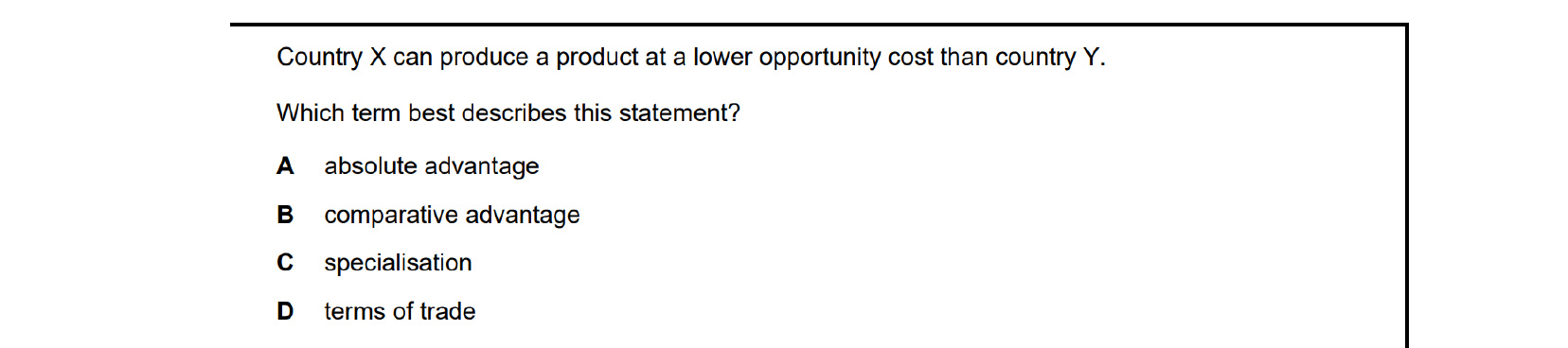
Comparative advantage is defined as the ability to produce a good at a lower opportunity cost than another country — exactly the situation described. Absolute advantage refers to producing more output from the same resources, specialisation is the resulting reallocation of production, and terms of trade refers to the ratio of export to import prices. Only comparative advantage fits the definition.
25.2The benefits of specialisation and free trade (trade liberalisation)
Free trade is international trade in goods and services without government restriction. Under free trade, firms export and import the quantities they wish without taxes on trade, quantitative limits, subsidies designed to give artificial cost advantages, or excessive paperwork.
Free trade allows resources to be used more efficiently because countries can specialise in the products in which they have a comparative advantage. Specialisation in line with comparative advantage raises world output, supports employment in those activities and so tends to raise living standards. Because factor endowments differ between countries, free trade allows countries with fertile land and a suitable climate to specialise in particular crops while countries with deep financial sectors and well-educated workforces specialise in financial services.
Competition from imports puts pressure on domestic firms to keep prices and costs down and to raise quality. Consumers therefore tend to enjoy lower prices and better products than they would in a closed market. Domestic firms also gain access to a wider range of raw materials and capital goods, often at lower prices. Selling into an international market allows firms to produce on a larger scale and so exploit economies of scale that the home market alone could not support. Consumers benefit from greater variety because they can buy products that the domestic economy does not produce.
Trading possibility curve
A trading possibility curve shows the consumption combinations available to a country once it specialises and trades. With the two goods on the axes, the production possibility curve shows the combinations the country can produce on its own. If the country specialises in the good in which it has a comparative advantage and exchanges some of that output for the other good on world markets at a rate more favourable than its domestic opportunity cost ratio, the trading possibility curve lies outside the production possibility curve. The country can therefore consume bundles of the two goods it could not produce on its own. The diagram makes the central point: a country cannot produce outside its PPC, but international trade lets it consume outside its PPC (see Figure 25.4).
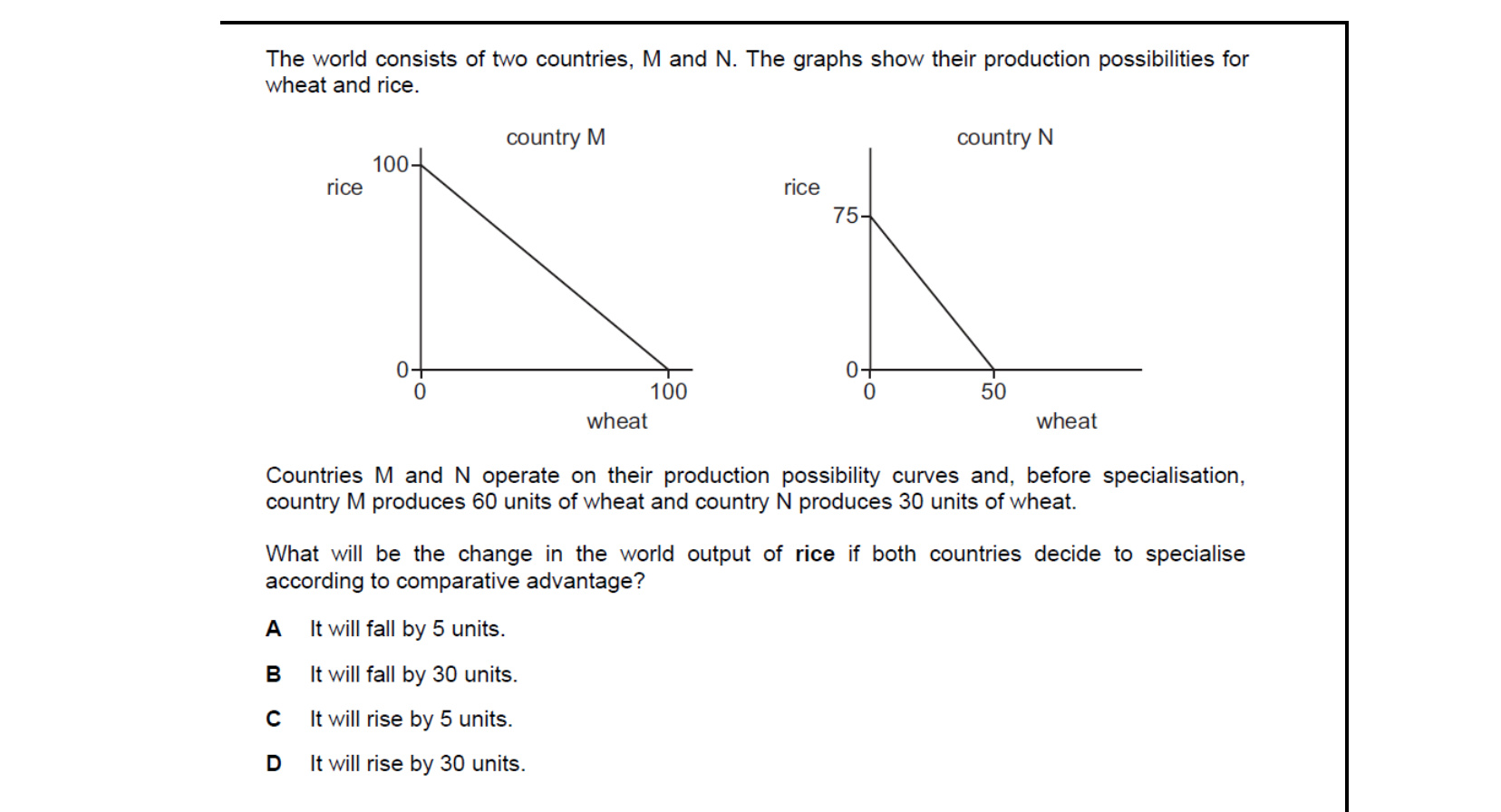
Read the PPCs: country M's opportunity cost of wheat is lower than N's, and N's opportunity cost of rice is lower than M's. Reallocating production so each country specialises in line with comparative advantage shifts each country toward the good in which it is comparatively efficient. Calculating the resulting world output change in rice from the diagram gives an increase of 5 units — option C.
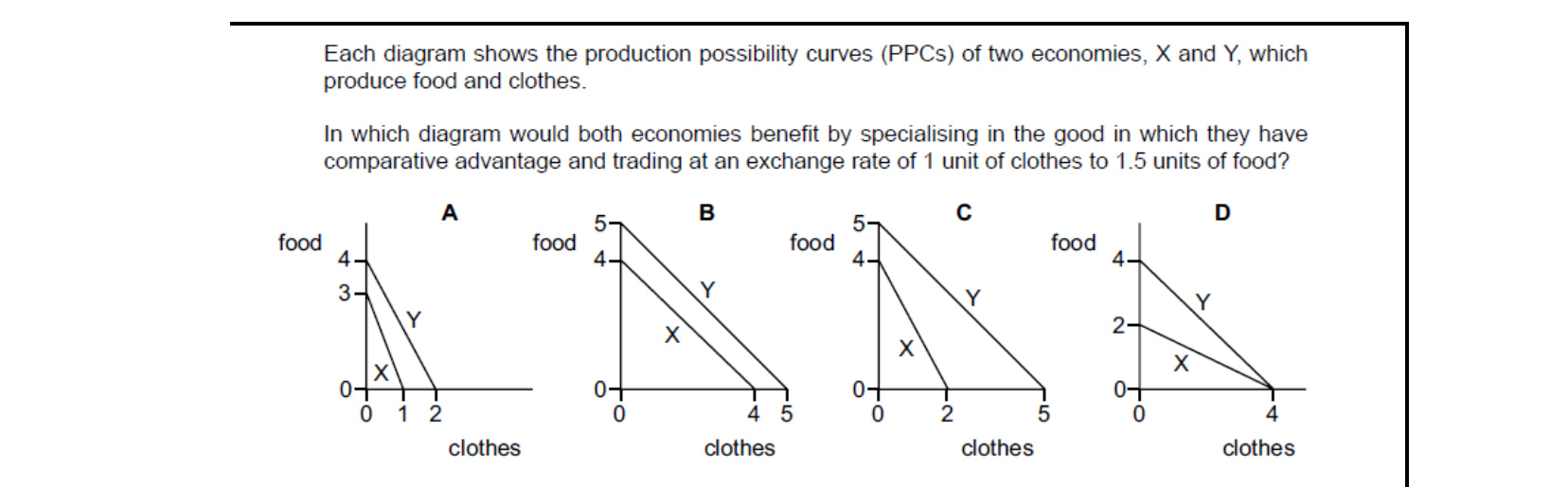
Both countries gain when the trade exchange rate lies between the two countries' domestic opportunity-cost ratios. The diagram in which one country can trade 1 clothes for less than 1.5 food domestically (so gains by exporting clothes for food) while the other can trade 1 clothes for more than 1.5 food domestically (so gains by exporting food for clothes) is the only one where the 1c:1.5f rate falls between them — diagram C.
25.3Exports, imports and the terms of trade
The gain a country gets from trade depends on how many imports it can buy with the revenue earned from its exports. That in turn depends on the prices it receives for its exports relative to the prices it pays for its imports.
Measurement of the terms of trade
The terms of trade is a numerical measure of the ratio of export prices to import prices, expressed as an index. The average prices used are weighted by the relative importance of each product traded. The formula is:
Terms of trade index = (index of export prices / index of import prices) × 100
A rise in the index is described as a favourable movement or an improvement in the terms of trade: fewer exports now have to be sold to buy any given quantity of imports. A fall in the index is described as an unfavourable movement or a deterioration: more exports must be exchanged to obtain the same quantity of imports.
Causes of changes in the terms of trade
A favourable movement occurs when export prices rise relative to import prices. This can happen if export prices rise by more than import prices, or if export prices remain unchanged while import prices fall. An unfavourable movement occurs when export prices fall relative to import prices — for instance, when import prices fall by less than export prices or when import prices rise while export prices fall.
The underlying causes are changes in the demand for and supply of a country's exports and imports, changes in the domestic price level, and changes in the exchange rate. A rise in foreign demand for a country's exports tends to push up export prices and so generates a favourable movement. A higher domestic inflation rate (relative to trading partners) raises export prices relative to import prices. Deliberate action by a government to lower its exchange rate is sometimes called a deliberate deterioration of the terms of trade: the policy reduces the foreign-currency price of exports and raises the domestic-currency price of imports in order to make domestic products more internationally competitive.
The Prebisch–Singer hypothesis suggests that the terms of trade tend to move against countries that specialise in primary products. The argument is that demand for manufactured goods and services grows by more than demand for primary products as incomes rise. The relative prices of some agricultural products have fallen in recent years, although the prices of certain commodities have shown considerable volatility.
The impact of changes in the terms of trade
A favourable movement is not automatically beneficial. The effect depends on the cause. If export prices rise because foreign demand for the country's products has increased, more exports are sold at a higher price, so export revenue rises and the movement is beneficial. If instead export prices rise because production costs have risen, foreign demand for the country's products is likely to fall and export revenue may decline.
Likewise, an unfavourable movement is not automatically harmful. If demand for exports and imports is price elastic, a fall in export prices relative to import prices will raise export revenue relative to import expenditure and can therefore reduce a current account deficit. The terms of trade should not be confused with the balance of trade: the terms of trade measures relative prices, not the value of trade.
25.4Limitations of the theory of absolute and comparative advantage
Absolute and comparative advantage do not give a complete account of the pattern of international trade. A number of practical limitations should be considered.
- Government policy on overspecialisation. Some governments deliberately avoid specialising heavily in a small number of products because of the risks attached — for example, the risk that demand for those products may collapse.
- Transport costs. The cost of moving goods between countries can be high enough to wipe out a comparative advantage in production.
- The exchange rate. For both countries to gain, the rate at which the two goods exchange must lie between the two countries' domestic opportunity cost ratios. If the exchange rate moves outside this range, one country will gain little or nothing.
- Trade restrictions. Other governments may impose tariffs, quotas, subsidies or other barriers that prevent the gains from comparative advantage from being realised in practice.
Mobility of resources and constant returns
The theory of comparative advantage assumes that resources are mobile between industries and that production exhibits constant returns. Neither assumption holds perfectly. If a country decides to double output of one product, there is no guarantee that workers and other resources can switch quickly from the industry being scaled down. Where they cannot, structural unemployment rises. Even where resources do switch, the extra resources may be less productive than those already employed, so doubling resource use may not double output.
Adjustment to changes in comparative advantage
Comparative advantage is not fixed: it can shift as technology, factor quality and relative costs change. Countries do not always adjust smoothly. A country that has lost the comparative advantage in, say, steel production may continue producing steel for some time. Producers in the industry may lobby government for protection against imports from the country that has gained the advantage. In a world of many countries and many products, it can also be difficult to identify exactly where a country's comparative advantage lies, particularly when production processes are split across borders.
Key concept link — The margin and decision-making
Countries have a limited quantity of resources so they cannot produce all they would like to. The theory of comparative advantage can help them decide how to use their resources. It suggests they should concentrate on producing those products they are most efficient at producing.
End-of-chapter practice
Past-paper questions from CIE 9708. Pick A, B, C or D. Answers are saved on this device — press Download report (PDF) at the top to save them.
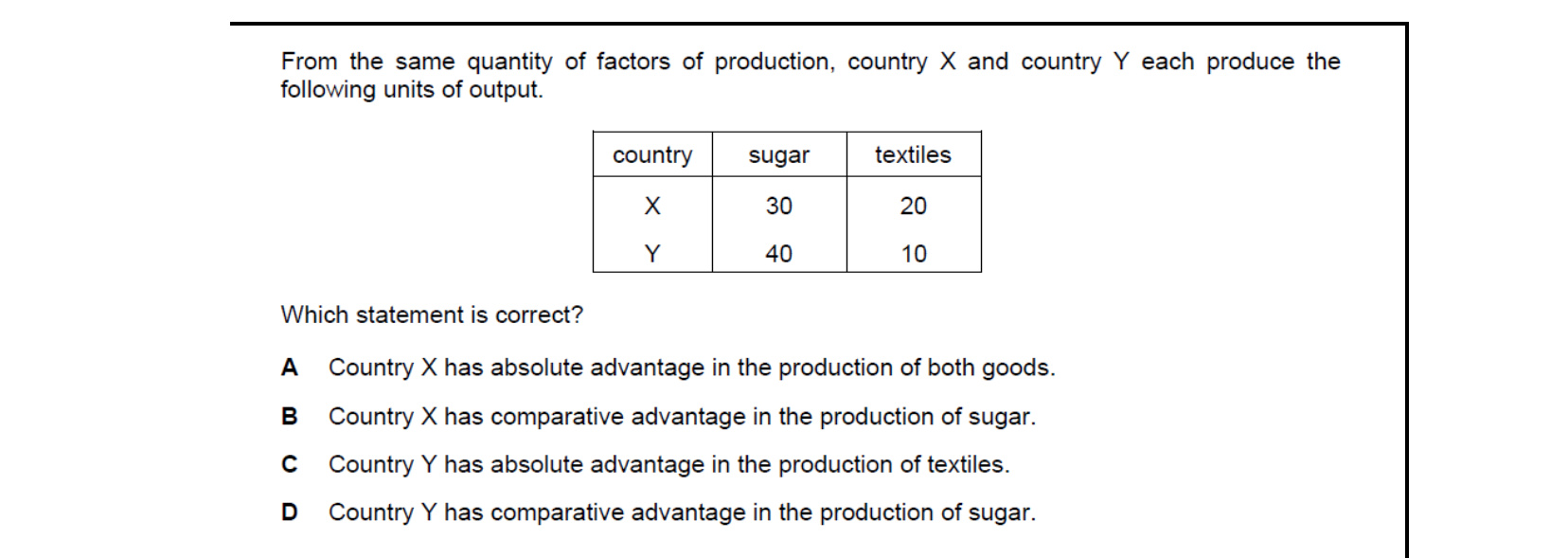
Opportunity costs: in country X, 1 textile costs 60/30 = 2 sugar (so 1 sugar costs 0.5 textile); in country Y, 1 textile costs 40/10 = 4 sugar (so 1 sugar costs 0.25 textile). Y gives up only 0.25 textile per sugar versus X's 0.5, so Y has a lower opportunity cost in sugar — Y has comparative advantage in sugar.

Terms of trade improve when export prices rise faster than import prices (or fall less slowly). The ratio of export to import prices rises most when export prices climb 10% while import prices climb just 5% — this raises the index of the terms of trade. The other combinations all reduce or fail to improve the ratio.
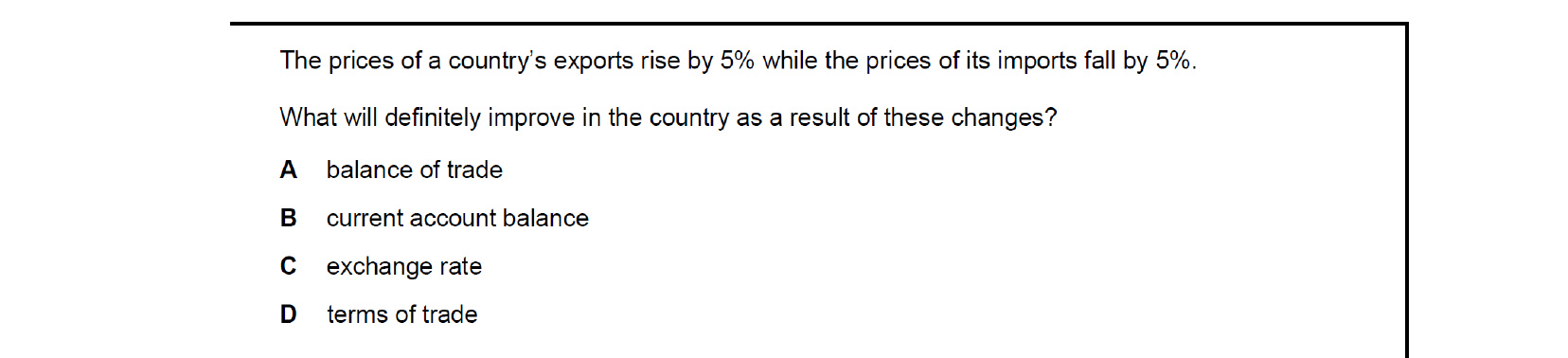
Terms of trade is defined as (export price index ÷ import price index) × 100. With export prices rising 5% and import prices falling 5%, the ratio rises unambiguously — the terms of trade definitely improve. The balance of trade and current account depend on quantities and elasticities (which can move either way), and exchange rate movements depend on many other factors.
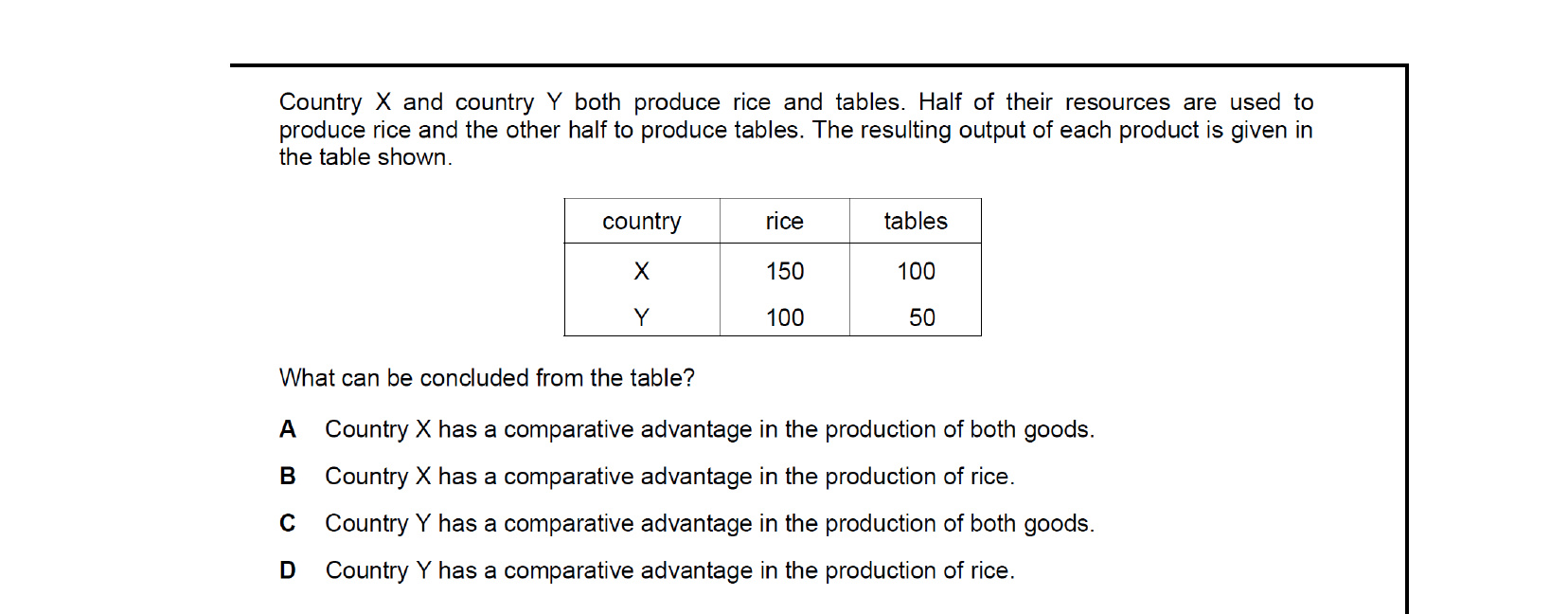
Comparing the two countries: country Y produces more of both goods with the same resources, so Y has the absolute advantage in both. To find comparative advantage, compare opportunity-cost ratios — the country with the lower opportunity cost in rice (i.e. gives up less in tables per unit of rice) is the country with the comparative advantage in rice. The figures imply that this is country Y, so Y has the comparative advantage in rice.
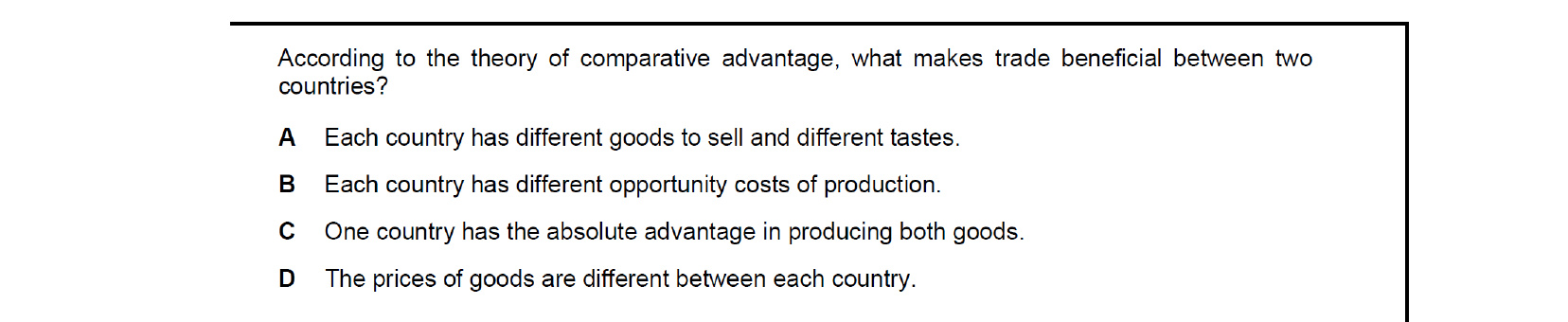
Comparative-advantage theory says trade benefits two countries when their relative opportunity costs of production differ. That difference creates scope for each country to specialise in the good it produces at the lower opportunity cost and trade for the other, with both ending up better off. Different tastes, absolute dominance in both goods or different prices alone are not the theoretical basis of gains from trade.
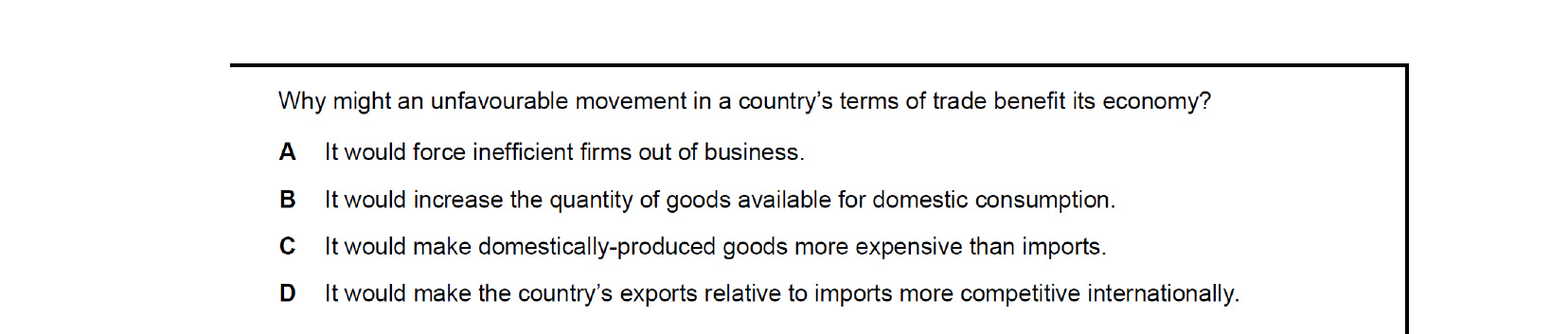
An unfavourable terms-of-trade movement means export prices fall relative to import prices. Although each unit of exports buys fewer imports, the country's exports become cheaper on world markets — more internationally competitive. Higher export volumes can boost output, employment and (if demand is elastic) export revenue, which is the silver lining of a terms-of-trade deterioration.
Attempt the practice questions above to build your score.
Self-evaluation checklist
After studying this chapter, you should be able to:
- Explain how a country may have absolute advantage when it can produce a product using fewer resources than another country
- Explain how a country has a comparative advantage when it can produce a product at a lower opportunity cost
- Discuss the benefits of specialisation and free trade: efficient use of resources based on comparative advantage, low prices, high quality, high output and choice
- Understand that the trading possibility curve shows how a country can consume more products as a result of specialising and trading
- Explain that the terms of trade is a measure of the ratio of export prices and import prices
- Explain why the effect of changes in the terms of trade depends on their cause
- Consider the limitations of absolute and comparative advantage
Want more practice? Drill this chapter's past-paper MCQs (134 questions) →